Subterranean termite interception addresses the high water-table conditions common to Sacramento neighborhoods like Pocket-Greenhaven, Natomas, and Land Park. The Western subterranean termite nests deep in moist…
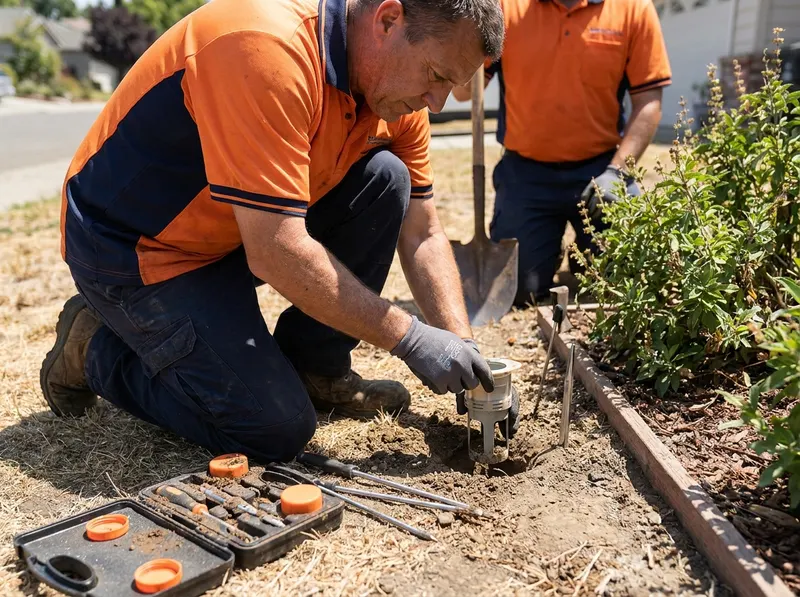
Subterranean termite interception addresses the high water-table conditions common to Sacramento neighborhoods like Pocket-Greenhaven, Natomas, and Land Park. The Western subterranean termite nests deep in moist river-basin soils, building subterranean shelter tubes upward over concrete stem walls and through cold joints in slabs. Unlike broad-spectrum surface sprays that evaporate under Central Valley summer heat or wash away during winter river rises, physical interception relies on cellular monitoring stations paired with undetectable chitin synthesis inhibitors or transfer-effect liquid termiticides. Foraging workers encounter the interception matrix, feed without detection, and track the active compound back to the subterranean nest, eliminating the primary reproductive core without indoor chemical aerosolization.
Older architectural styles in East Sacramento, the Fab 40s, and Curtis Park feature raised foundations with low crawl spaces, mudsills set near exterior grade, and unsealed perimeter brick. In these structures, localized trenching and rod-injection establish a continuous chemical boundary 6 inches wide by 6 inches deep directly against the foundation footing. For slab-on-grade homes common in South Natomas and Tahoe Park, treatment involves sub-slab core drilling adjacent to plumbing penetrations and exterior station arrays. Interception systems prevent interior displacement, allowing structural wood members to remain undisturbed while stopping sub-grade access routes.
Choosing continuous interception stations over full structural fumigation fits properties where infestation remains confined to foundation footings and sub-grade soil. Fumigation treats drywood termites nesting entirely within above-ground lumber, but it deposits zero active residuals in the soil, leaving slab edges exposed to subterranean colonies within weeks. Interception targets the sub-grade colony directly at property boundaries, offering persistent exterior defense. The technical trade-off involves physical intervention: properties bordered by continuous concrete aprons or patio slabs in Midtown require precision diamond-core drilling at 12-inch increments to access the soil interface below.
Every job gets a firm, written price after a free on-site visit.
Tell us about your subterranean termite interception job in Sacramento and we'll send a clear, written quote, usually the same day.
 Tavion Pest Defense